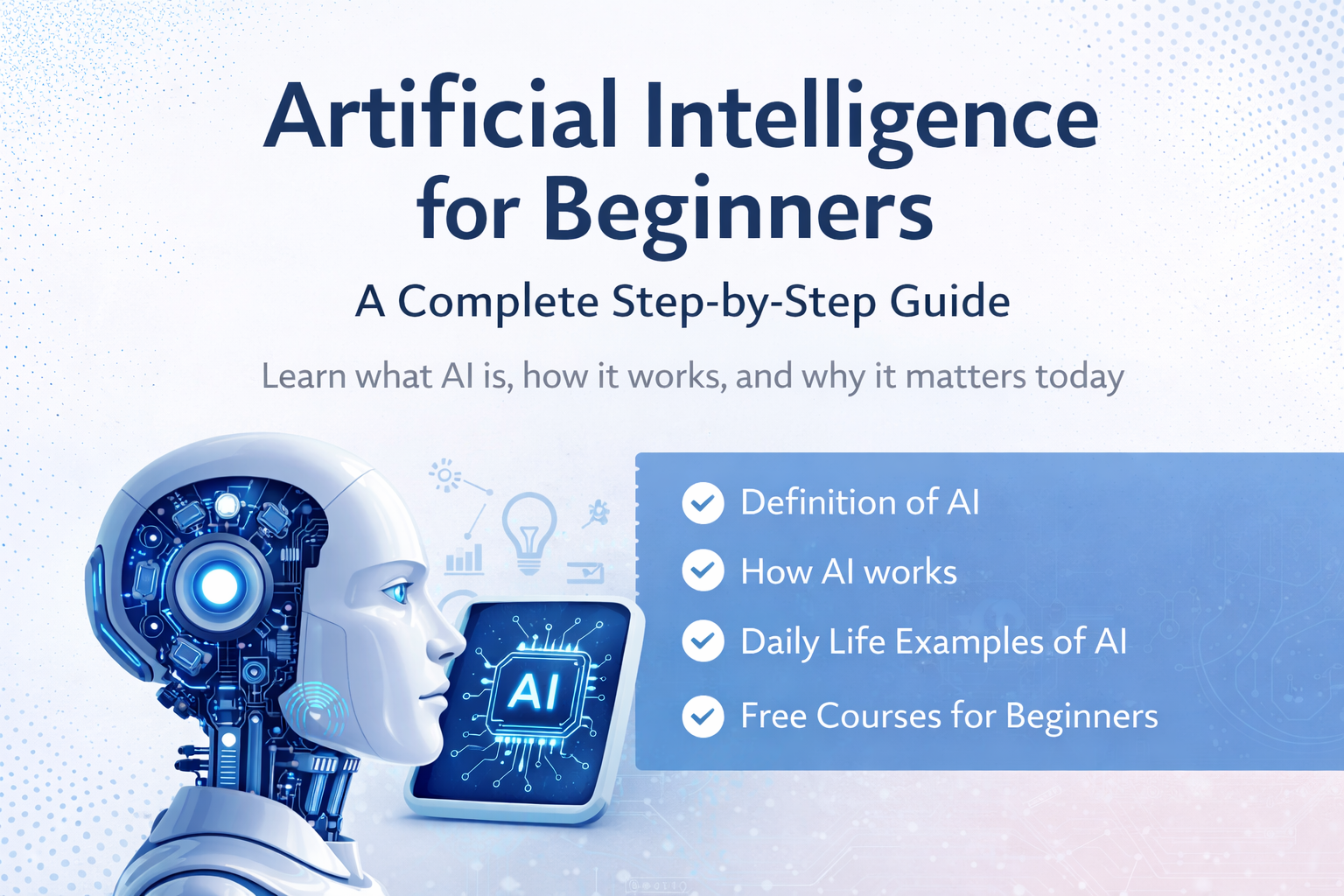
Artificial Intelligence for Beginners: A Simple and Complete Guide
Artificial Intelligence for Beginners is one of the most searched topics today, and for good reason. Everyone is talking about Artificial Intelligence (AI)—on social media, news channels, in offices, schools, and even in daily conversations.
This is the perfect time to start learning AI because it is already shaping the way we work and live. The longer you delay understanding AI, the more challenging it may become to keep up with future opportunities.
Many people believe AI is only meant for programmers, engineers, or technical professionals. In reality, AI is for everyone. Whether you are a student, teacher, business owner, freelancer, employee, or content creator, AI can help you in your daily work. You do not need a technical background to understand AI or to use AI-powered tools.
If you are confused about how to learn AI from the beginning, this guide will help you understand:
- What Artificial Intelligence really is
- How AI works in simple terms
- Daily life examples of AI
- Whether AI will replace jobs
- Why learning AI is important today
- Free AI courses for beginners
By the end of this article, you will have a clear understanding of AI and feel confident about starting your AI learning journey.
Why Learning Artificial Intelligence Is Important Today
AI is no longer a future concept. It is already a part of our lives. Educational institutions have started including AI in their curriculum, and companies are using AI tools to save time and increase efficiency. Professionals who understand AI already have a competitive advantage.
If you have not learned AI yet, there is no reason to panic. AI is not something difficult or scary. It is simply a tool that helps humans work smarter. Learning AI does not mean you must become a software developer. It means you should understand how AI works and how to use it effectively in your field.
What Is Artificial Intelligence (AI)?
Simple Definition of AI
Artificial Intelligence (AI) is a technology that analyzes large amounts of data, identifies patterns, and uses those patterns to make decisions, predictions, or generate results.
In very simple words, AI:
- Collects information (data)
- Studies and understands that data
- Finds repeating patterns
- Uses those patterns to give useful outputs
AI learns from data in the same way humans learn from experience.
Understanding AI with a Simple Example
Think about this sentence:
“Once upon a ___”
Most people immediately think of the word “time.”
This happens because your brain has seen this sentence many times before and learned the pattern.
AI works in a similar way.
AI systems read millions of texts, documents, and examples. From this data, they learn:
- Which words usually come together
- How sentences are formed
- How questions are answered
When you ask AI a question, it predicts the best possible answer based on the patterns it has learned.
What Does “Pattern Recognition” Mean in AI?
Pattern recognition means understanding how things usually behave based on past data.
For example:
- What videos people watch after watching a comedy video
- Which road is faster during peak hours
- What product a customer is likely to buy next
- What word should come next in a sentence
AI studies historical data to make these predictions.
So AI is not magic — it is data, logic, and mathematics working together.
How Does AI Work? (Beginner-Friendly Steps)
Step 1: Data Collection
Data is the foundation of AI. AI systems use different types of data, such as:
- Text (articles, books, websites)
- Images
- Videos
- Audio recordings
- Numbers and statistics
The more high-quality data AI has, the better it performs.
Step 2: Learning from Data
After collecting data, AI analyzes it to find:
- Similarities
- Differences
- Repeated patterns
This learning process is known as Machine Learning.
Just like humans improve with experience, AI improves with more data.
Step 3: Training and Improvement
AI systems are trained over time. During training, AI:
- Makes errors
- Learns from those errors
- Improves accuracy step by step
This continuous improvement makes AI smarter and more reliable.
Step 4: Producing Results
Once trained, AI can provide useful outputs such as:
- Written answers
- Voice responses
- Image recognition
- Personalized recommendations
- Predictions and suggestions
This is how AI supports us in daily life.
Real-Life Examples of AI You Use Every Day
Google Maps
Google Maps uses AI to suggest:
- Fastest routes
- Traffic updates
- Estimated travel time
Smartphones and Keyboards
AI helps when your phone:
- Corrects spelling
- Predicts the next word
- Converts voice into text
Social Media Platforms
Platforms like Instagram, YouTube, and Facebook show personalized content because AI studies:
- What you watch
- How long you watch
- What you like or skip
Netflix and Amazon
- Netflix recommends shows based on viewing history
- Amazon suggests products based on searches and purchases
All these features are powered by AI.
Will AI Take Away Jobs?
This is a common concern, but the reality is simple:
❌ AI will not replace humans
✅ People who use AI effectively will replace those who don’t
AI is a tool. It cannot replace human creativity, emotions, or critical thinking. However, professionals who know how to use AI tools can work faster and more efficiently.
So instead of fearing AI, learning it is the smartest choice.
Important Things to Know About AI
- AI is not always correct and can make mistakes
- Important information should always be verified
- AI should be used ethically and responsibly
AI itself is neutral. Its impact depends on how humans use it.
Can Non-Technical Beginners Learn AI?
Yes, absolutely.
You do not need:
- Programming skills
- Engineering background
- Advanced mathematics
You only need:
- Curiosity
- Willingness to learn
- Consistency
Many beginner-friendly AI courses are designed specifically for non-technical learners.
Free AI Courses for Beginners
1. Google – AI for Everyone
- Beginner-friendly
- No coding required
- Available on Coursera (free audit option)
2. Microsoft Learn – AI Fundamentals
- Completely free
- Short and easy lessons
- Practical AI concepts
3. IBM – Introduction to Artificial Intelligence
- Free on Coursera
- Real-world examples
- Ideal for beginners
4. YouTube Learning
Search for:
- “AI for beginners”
- “Artificial Intelligence explained simply”
- “AI course for non-technical users”
Choose educators who explain concepts clearly and simply.
How to Start Learning AI (Simple Roadmap)
- Learn basic AI concepts
- Understand how AI works
- Explore popular AI tools
- Use AI in daily tasks
- Go deeper only if interested
There is no need to rush. Consistent learning is more important than speed.

Related Posts