This guide explains how to get a job in 2026 without a degree, the most in-demand skills, industries hiring skill-based talent, and step-by-step actions to build a successful career.
The job market in 2026 looks nothing like it did ten years ago. Earlier, a college degree was seen as the key to a stable and high-paying job. Today, employers care far more about skills, hands-on experience, and real results than academic qualifications.
Companies are no longer asking “Which college did you attend?” Instead, they ask “What can you build, solve, or improve?”
This shift has created massive opportunities for people who do not have a traditional degree but are willing to learn and grow.
How to Get a Job in 2026 Without a Degree
Why Degrees Are Losing Importance in 2026
Several global changes have reduced the importance of formal degrees:
1. Skill-Based Hiring Is the New Standard
Companies want employees who can handle real-world tasks from day one. A degree does not guarantee practical ability, but skills do.
2. Rise of Affordable Online Education
Platforms like Coursera, Udemy, Google, Airtribe, and YouTube provide industry-ready skills at low or zero cost.
3. Startup and Remote Work Culture
Startups and remote-first companies focus on performance, speed, and outcomes—not certificates.
4. Rapid Technology Evolution
AI, automation, and digital tools change fast. Continuous learning matters more than one-time degrees.
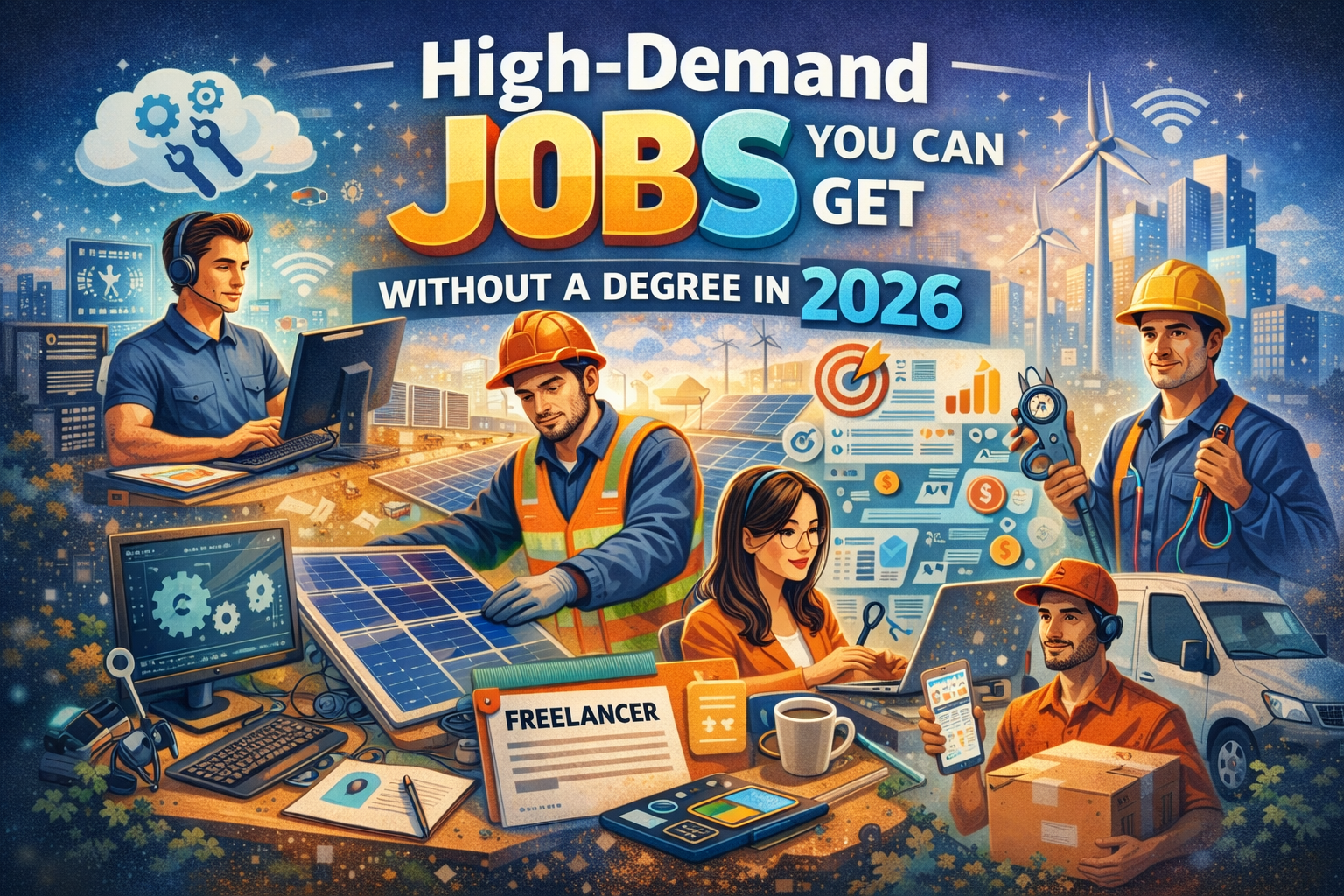
High-Demand Jobs You Can Get Without a Degree in 2026
1. Digital Marketing Careers
Digital marketing continues to grow rapidly across industries.
Popular roles:
- SEO Executive
- Social Media Manager
- Performance Marketer
- Content Strategist
- Email Marketing Specialist
Skills needed:
- SEO and keyword research
- Google Ads & Meta Ads
- Analytics tools
- Content creation and strategy
Proven results like traffic growth and lead generation matter more than degrees.
2. Tech Jobs Without a Computer Science Degree
You can enter tech through skills and projects alone.
Roles include:
- Web Developer
- Frontend or Backend Developer
- QA Tester
- No-Code Developer
Key skills:
- HTML, CSS, JavaScript
- React, Node.js, Python
- GitHub and version control
- Logical thinking and debugging
Self-taught developers are regularly hired based on portfolios.
3. Data and AI-Related Roles
Even data careers are becoming accessible without formal education.
Job options:
- Data Analyst
- Business Analyst
- AI Prompt Engineer
- Data Visualization Specialist
Skills required:
- Excel and Google Sheets
- SQL and Python
- Power BI or Tableau
- AI tools like ChatGPT
Projects and certifications matter more than degrees.
4. Freelancing and Remote Work
Freelancing allows you to earn purely based on skill.
High-paying freelance skills:
- Graphic Design
- Video Editing
- Copywriting
- Web Design
- Social Media Management
Platforms like Upwork and Fiverr hire based on portfolios and reviews.
5. Sales and Business Development
Sales roles reward performance, not qualifications.
Roles include:
- Inside Sales Executive
- Business Development Manager
- Account Executive
- Customer Success Manager
Strong communication and closing skills are enough to succeed.
6. Content Creation and Creator Economy
The creator economy is booming in 2026.
Career paths:
- YouTuber
- Blogger
- Instagram Creator
- Podcaster
- UGC Creator
Brands care about engagement and audience trust—not degrees.
Step-by-Step Guide to Getting a Job Without a Degree
Step 1: Choose One Skill and Focus
Avoid learning everything at once. Pick one skill based on:
- Interest
- Market demand
- Daily practice potential
Commit for at least 6–12 months.
Step 2: Learn from the Right Sources
You do not need expensive colleges. Use:
- Online courses
- YouTube tutorials
- Industry blogs
- Practice platforms
Focus on practical learning.
Step 3: Build Real-World Projects
Projects prove your ability.
Examples:
- Create a website for a local business
- Run ads with a small budget
- Grow a blog organically
- Analyze real datasets
In 2026, projects replace degrees.
Step 4: Create a Professional Portfolio
Your portfolio should include:
- Short introduction
- Skills list
- Projects with results
- Contact information
Use GitHub, Notion, or a personal website.
Step 5: Build a Strong Online Presence
Recruiters check your digital footprint.
Action steps:
- Optimize LinkedIn profile
- Share learning progress
- Post case studies
- Network with professionals
Your online profile becomes your resume.
Step 6: Apply Smartly, Not Randomly
Avoid mass applications.
Instead:
- Apply to 10 relevant jobs daily
- Customize your resume
- Write personalized cover letters
Quality applications get better results.
Step 7: Prepare for Skill-Based Interviews
Modern interviews test:
- Practical skills
- Live problem-solving
- Case studies
- Portfolio explanation
Practice explaining your work clearly.
How to Earn While Learning
You can start earning early through:
- Freelancing
- Internships
- Paid apprenticeships
- Contract roles
- Remote gigs
Even small income builds confidence and experience.
Certifications That Actually Add Value (Optional)
Useful certifications are:
- Skill-focused
- Industry-recognized
- Project-based
Examples:
- Google Digital Marketing
- Meta Ads Certification
- AWS Cloud Practitioner
- Data Analytics certifications
Avoid collecting unnecessary certificates.
Common Mistakes to Avoid
- Chasing quick money
- Learning without practice
- Ignoring communication skills
- Inconsistent effort
Consistency beats motivation.
Mindset Needed to Succeed Without a Degree
Success depends on attitude.
Adopt this mindset:
- Stay curious
- Learn continuously
- Accept feedback
- Stay disciplined
- Think long-term
The Reality of Jobs Without Degrees
Getting hired without a degree is possible but requires effort.
You must:
- Learn independently
- Build proof through results
- Work harder initially
Once experience grows, your degree becomes irrelevant.
Future-Proof Skills for 2026 and Beyond
Focus on:
- AI tools and automation
- Digital and analytical skills
- Communication
- Problem-solving
These skills will remain valuable long-term.
Final Thoughts
In 2026, success is not defined by a degree but by skills, experience, and mindset. Whether you choose tech, marketing, data, freelancing, sales, or content creation, you can build a strong career without formal education.
Start today.
Choose one skill.
Practice daily.
Build projects.
Show results.
Your skills are your real degree in 2026.

Related Posts